SIX
(a short story)

Opening Note
This piece is not fiction. It is written as closely as possible to how the world appeared to me at the age of six: complete, orderly, reassuring, and only dimly aware of its own fragility. I have resisted the temptation to interpret events with the knowledge I later acquired, or to smooth memory into narrative shape. What follows is not an explanation of what happened, but a record of what was known, noticed, misunderstood, and taken for granted at the time.
If it reads as innocent, that is because it was. If it reads as incomplete, that is because it could only ever have been so. Only later did it become clear how much of my certainty depended on a single, ordinary day continuing as expected. But it didn’t.
It would mean the world to me if you would click on one of the two links after you have read the story:
***
I was a very worldly six-year-old, it had to be said. Happy, balanced, bright as a button. I was the first name on the register at school, despite neither of my initials being anywhere near the beginning of the alphabet, and I had already had a long-term girlfriend, Carolynn Hunt, who I had unceremoniously ditched after a year. This separation happened not long after Louise Brown, the freckle-faced and nice-smelling beauty, had arrived at the school six months earlier. I collected Britain’s Crusaders and Turks toy soldiers and even had ambitions of building my own Lego castle one day. Life was great, and Mummy told me I was her bonny little boy and everything in life would simply fall at my feet. Life was simple.
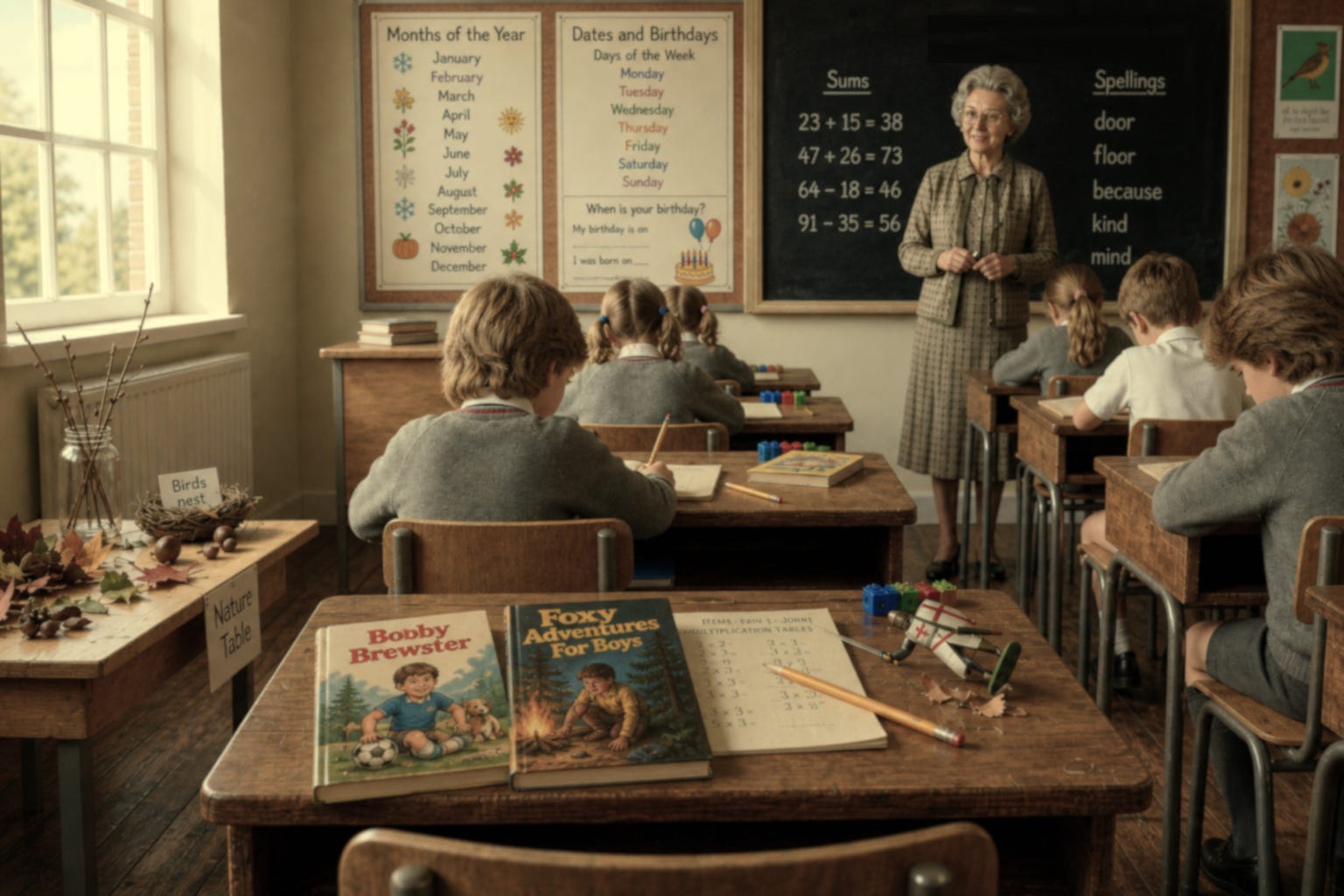
Daddy took me to swimming lessons each week and, even though I sometimes pretended to have tummy ache on Friday afternoons before the lesson, Jim said I was good at it and called me ‘Tarzan’. My mum used to take me to the library on Thursdays after school, where I would instantly dive into the Bobby Brewster section. I could take three books out a fortnight and I knew I could probably get through two Bobby Brewsters and an illustrated Usborne book on Dinosaurs without breaking a sweat. I was good at Sums and Scripture and I knew Jesus loved me. My mum knew that I would look after her when I was grown up, even though we all knew my sister wouldn’t be bothered, and my Nanna called me Jamore or Holy Joe. I liked it when Nanna deliberately spat her false teeth out when mummy wasn’t looking to make me laugh. Her eyes looked like pale blue marbles that would pop out of her head. Mummy used to pretend to be angry with her when she did that and tell her not to do it when Daddy was around. I didn’t know why, because Daddy used to sing funny songs for me and tell great stories. Mummy was a bad singer. She cried when I told her that and promised I would never hear her sing again. I cuddled her so tight and told her I was so sorry, but she never did sing again. That was three years before, when I was a little boy.
I used to come home from school for dinner. Posh people called it ‘lunch’ but everybody knew that they were wrong. I only lived a six-minute run from school and I was allowed to come home on my own as long as I promised to wait for the Lollipop Lady. I think she was called that because she always looked like she was sucking a lollipop in her cheek, but you could never see the stick. Mummy told me not to stare at her lump. She always called me and my mum ‘love’ when she guided us across the road. It was common to call people ‘love’ or ‘mate’, but most common people meant well. They were fine so long as I didn’t end up like them. Tuesdays filled me with anxiety because you never knew what you were going to get for dinner, because they could offer my beloved Sausage, Mash and Beans or the dreaded Potato Pie, unless it was summer and then we had Pork Pie (yum) and Salad (yuck).
On a train to a really strange far-away place called London, where they said “batter” when they meant “butter” (but that was OK because I knew what they meant and was only ever confused and bitterly disappointed the first time), somebody said something nice to my mum. “Do you know you have the best-behaved children I have ever seen?” I looked up from my woodland animals colouring book and smiled politely, to order. My mum was so proud of this that she mentioned it for years after – even when that could no longer be said to be true.
We lived in a close-knit community. Nanna Hilda lived in the house where my mum and My Arthur had grown up and I could hop-scotch there in five minutes so long as I held Mummy’s hand when I crossed the road. Her house always smelled of cigarettes and pickled things. Our house didn’t smell of cigarettes anymore because Mummy had promised me she wouldn’t smoke again after Mrs Hamer told us that each cigarette took five minutes off your life. I hated pickled things but I ate them anyway. Uncle Frank was Nanna Hilda’s brother and he lived in the next street. He was really funny, except on Christmas Eve when he made us cry and Mummy shout at him by telling us what presents Father Christmas had got us. How could he know this? Apparently, it was because he knew Father Christmas and had a really big gob.
My Arthur lived round the corner from Uncle Frank. You could do a circuit from our house to Nanna’s and then Uncle Frank and Aunty Dorothy’s, then on to Arthur’s and then back to ours. Our house was best though, because we could see the horses in the field from our back kitchen and they could only see a wall or flowers from their back kitchens. Arthur was a pig and I wasn’t to grow up like him on any account. His house smelled of chips and he always sang along to songs on the radio that were very different from the songs in our house. He told me funny stories and took me on long walks. Sometimes he used to do really smelly pumps. His tummy came over his trousers and he lived with my cousins, but they weren’t really my cousins at the same time. I didn’t mind that they weren’t my real cousins (though I hadn’t to tell anyone because of something called a DEE-EYE-VEE-OH-ARE-SEA-EE), because Joanne helped me build some wings and taught me how to fly, and Steve was in his room all the time listening to records, and Kath wore a leather jacket and sat on the back of a motorbike ridden by a man with long hair and a moustache.
On Saturday mornings Daddy used to take me to the Building Society. I didn’t like the Building Society because it was boring, but I knew it was important to look after your money and that, if I didn’t complain, Daddy would buy me a farm animal from Boydell’s Toy Shop next door. After that he would take me to Carr’s Pasties and we would get a bag of warm pasties and meat pies and some cold ones for the freezer. It was a well-known fact that Molly Bentham couldn’t make pasties as well as Carr’s. Even Norma couldn’t, and she baked the best flour cakes in Smithills. Besides, no party was a party without Carr’s Pasties, but it was OK to make your own sausage rolls though.
On Saturday Daddy used to play football. Sometimes he came home muddy, but most weeks he came back looking very clean and happy but red-faced, and his breath smelled a bit funny. Mummy asked me if I wanted to watch my dad playing football, but I had seen him playing before in the garden with my orange ball so I didn’t need to. Besides, Saturdays were about watching black-and-white films on BBC2 because that was the channel which didn’t have sport on it. Sometimes a man with dark, wet, combed hair used to put his mouth on the pretty lady’s mouth and they would cuddle each other. This was called ‘kissing’ because mummy told me she was doing it with daddy once in the bedroom before school when I walked in and I was a bit frightened. It was very different from kisses normal people did. I planned that I would trap Louise Brown in the corner of the rain shelter and do kissing to her like the black-and-white people did, but mummy found the piece of paper where I had written out my plan and I pretended it was all a joke. My face went bright red and everyone laughed.
Sometimes when it was raining, I used to listen to my records. Daddy had built a record storage place out of toasted bricks under the record player. I didn’t like ABBA like my Nanna Edith did. They were terrible. Embarrassing and nowhere near as good as Kenny Rogers and Elton John, who we liked in our house. I preferred The Jungle Book though, especially ‘The Bare Necessities’, but I also liked Burl Ives and Roger Whittaker. When I was alone, I liked to listen to a song by Roger Whittaker about a creeping spider. I used to lie on my tummy imagining the spider’s legs running down my body. When I listened to this, the song made my tummy feel funny. I didn’t want Mummy and Daddy to know about this for some reason.
I liked PE at school because we used to climb up bars and bounce balls. PE was fun, but I got done off Mrs Wilkinson one time because Michael Lavery had to do PE in his undies and I told her he had poo in them at the back. I was wrong though, because that was just the design of the underpants. Everybody laughed when I said it, but I cried when I realised I was wrong.
We used to go to North Wales on holiday. That was brilliant because they had castles and rock pools and Daddy showed me how to get limpets and to build sand castles while mummy tried to get a tan behind the windbreak. Scarborough was rubbish and so was Blackpool, although I had never been to Scarborough. Blackpool was OK though during the illuminations just after school started again, because you could drive your car along the seafront and have The Sorcerer’s Apprentice and Snow White above your head in bright flashing colours. We stayed in Uncle Alvin’s caravan in Blackpool once and I had a bad dream that the miner whose face lit up in the Gold Mine ride was my grandad. I cried because it was really dark and echoey and I was really scared in the Gold Mine, and also my Grandad had died two years before and my Nanna got a dog instead.
I could do a good American accent because that was how they talked in the films and Alias Smith and Jones. They didn’t make films in England. Only in America and another place I couldn’t remember the name of, but I thought that it might have been Peru. The old films were black and white but they were “talkies”, unlike Harold Lloyd on the TV, who was always on in the school holidays. All the new ones were cartoons and they only showed those at the cinema, and you only went to the cinema when Daddy was off work on a Friday. Then they started making films with colour and real people. I knew they did this because Daddy took me to see the very first one ever made: a film called Superman 2. It was brilliant and I wanted to wear my underpants outside my pants but Mummy wouldn’t let me.
We had a dressing-up box in the spare room. It was like a big blue barrel and a quick search of the arm instantly turned us into goodies or baddies. I liked being the sheriff because I was a good boy, but my sister, Rache, was often the baddie/Indian. I had a cap gun and she had a bow and arrow that she didn’t know how to use, so the goodies always won. Plus, I had a faster hobby horse than she did.
I had my own bedroom with an open fireplace that used to make haunting noises at night and sometimes I was scared. I had blue and white baseball pyjamas which always smelled nice. Baseball was a bit like funny cricket. A stupid sport, but I hadn’t seen it. They played it in America. Americans did lots of stupid things.
I used to sit in the corner furthest away from the door next to Tim Tannahill and near the Nature Table. If Mrs Hamer was sitting at her desk working, I could look at her straight on without it looking like I was looking at her. I liked watching her. She was kind and had big glasses.
One Wednesday I was doing my sums in my buff book when Mrs Hamer stood up suddenly and walked to the classroom door. I looked back to my work because it was taking away and I needed to concentrate harder on that than adding up. We had a visitor. I finished my sum and Mummy was standing at the front of the class. Mrs Hamer called me over. My book and pencil lay waiting on the table.
“Come on, son. We’re going on holiday,” Mummy said.
“Now? But I…”
“Yes. Come on. Quickly.”
Mrs Hamer smiled at me and rubbed my hair and I left the room holding mummy’s hand, walked down the corridor and out of the gate to the waiting car, and I never saw Mrs Hamer or Louise Brown ever again.
I adored it James..congratulations!
Ah the bygone innocence of youth!